We don't just advise. We build. Product development, websites and apps, digital products, MVPs, custom technology, AI integration and business automation — for businesses and independents. One operator scopes it, builds it, ships it and keeps it alive, so what you end up with is the thing your business actually needs, not the closest template to it.
You do not need a spec, a deck or a technical co-founder. You need the idea and an honest description of the problem. The rest is our job.
Concept → working product or system → launch → operation. Integrate AI into a business that already exists. Automate the work nobody should still be doing by hand. Build an AI-powered product from nothing. Turn an idea into something that runs — and, if you want, keep us running it.
Tell us the idea →Still taking bookings in WhatsApp?
Then you're also losing them in a thread at 1am. A booking flow that confirms, reminds and records itself pays for itself in about a month.
Is your website a business card?
It looks fine. It sells nothing, captures nobody, and hasn't moved since the day it launched. A site should be doing a job, not sitting there.
Typing the same data in twice?
Every hour spent moving numbers between two tools is an hour a script would do for free, at 3am, without a typo.
Does your best process live in one person's head?
That isn't a system. That's a risk with a name on it — and it goes on holiday in August.
Paying for six tools that don't talk?
Most stacks are two integrations and one honest afternoon away from working properly. Nobody has sat down and done it.
Everyone says "use AI." Nobody says how.
Right — and that's the actual job: finding the two places it saves you real hours, building those, and ignoring the noise.
Not a brochure. A site built around the one action you need a visitor to take — enquire, book, buy, apply — with the copy, the structure and the speed to make it happen. Multilingual where you need it, fast on a phone everywhere.
The thing your customers open, use and come back to. Booking and ordering flows, member areas, catalogues, installable web apps that live on a home screen without an app store standing in the way.
The hours you get back. Quotes that write themselves, enquiries that route themselves, reports that arrive on Monday without anyone building them. Where AI genuinely helps, it goes in. Where it's decoration, it doesn't.
The company's nervous system. Client and lead tracking, stock and supplier tools, staff scheduling, a dashboard that shows the number you actually manage by — replacing the spreadsheet that's been doing a system's job for three years.
Not a strategy document about AI. The two or three places in your operation where it removes real hours — an assistant that answers what your team keeps answering, an agent that handles a routine end to end, a workflow that reads, decides and files without a person in the middle.
The idea that doesn't exist yet. We shape it into something buildable, cut it down to the version worth shipping first, and put a real product in front of real users — AI-powered where that is the point of it, not where it is decoration.
A call about the business, not the technology. What eats your week, where money leaks, what you'd do with the time back. You'll leave with a straight answer — including "you don't need to build anything."
A written plan: exactly what gets built, what it costs, when it lands, and what it does not include. One price, agreed before a line of code exists. The plan is yours whether or not we build it.
A live link from the first week, so you watch it grow instead of waiting for a reveal. Weekly check-ins, plain language, no ticket system between you and the person building it.
Launch is the middle, not the end. We keep it fed, fixed and improving on a monthly arrangement — or we hand you the keys, the accounts and the documentation and walk away clean. Your call.
Anyone can show you a portfolio. These are six products we scoped, designed, built and shipped for ourselves — six different problems, six different shapes, all live right now. Open them. Break them. That's the pitch.
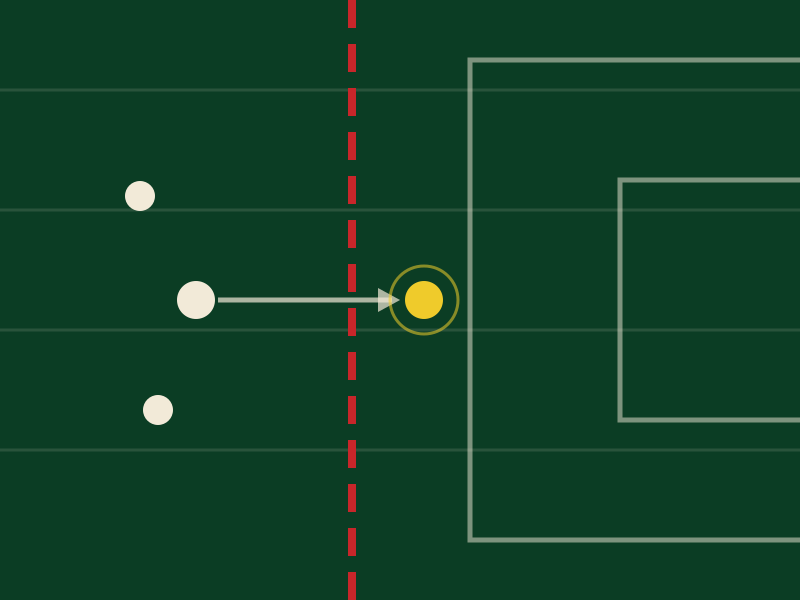
Onside or off? Call it.
One call a day, scoring, streaks, installable on a home screen. The retention loop most brands ask for and never get.
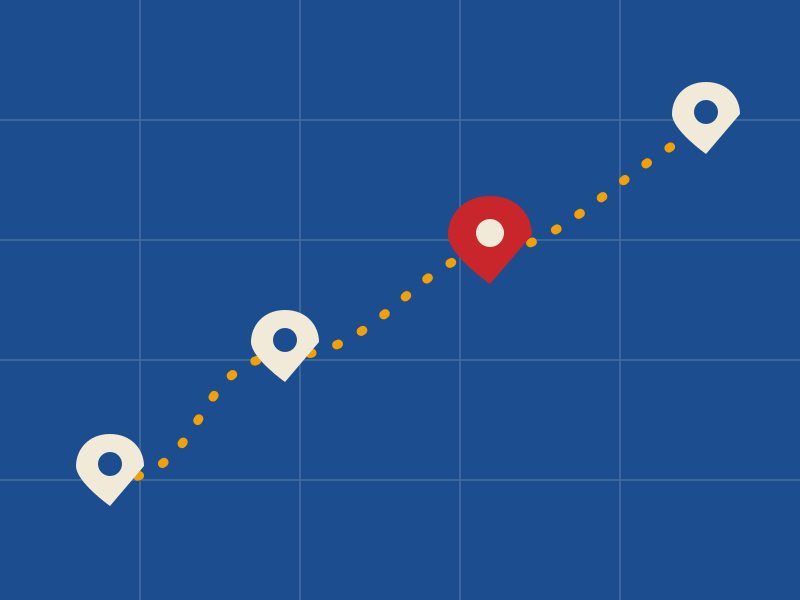
Your Athens, planned.
Three complete day plans in about thirty seconds. Curation logic, live data and a mobile-first flow that has to work on a street corner.
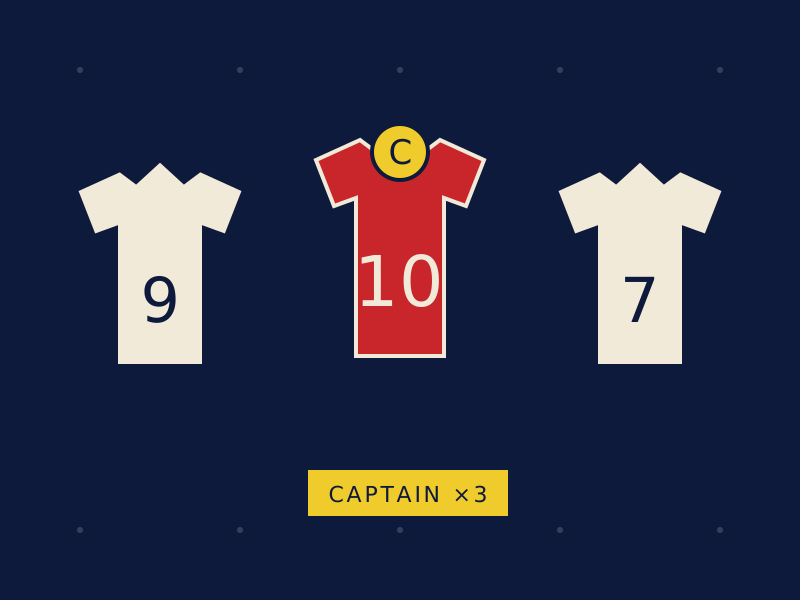
A little neighbourhood, a lot of football.
Fantasy football on live league data: squad rules, captain multipliers, cyclical rounds, standings — the hardest kind of build to keep correct every week.

The listeners' archive.
A large, cross-referenced Hebrew archive — timelines, sources, corrections workflow, right-to-left throughout. Content-heavy without being slow.
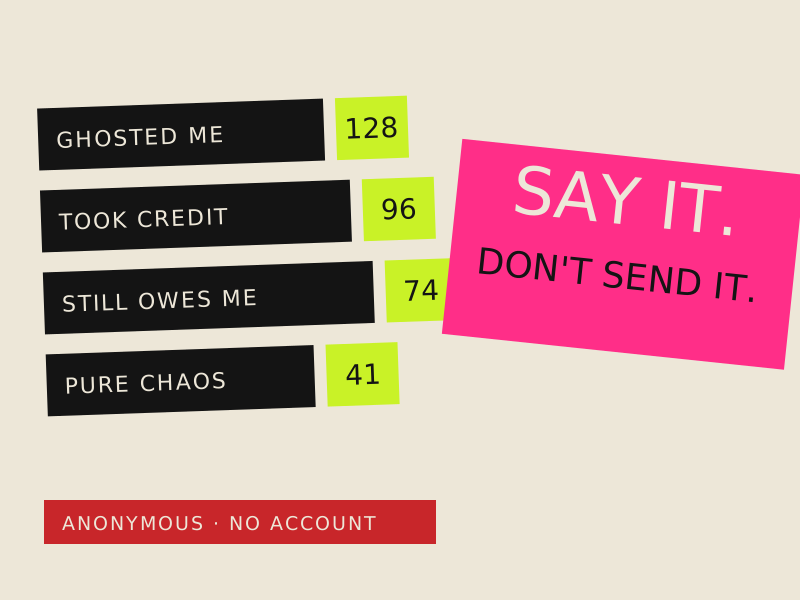
Say it. Don't send it.
User-generated content at speed: anonymous posting with no accounts, duplicate detection, community ranking, multi-script input and a moderation layer behind it.

Modern & contemporary.
A private-sale catalogue where restraint is the brief — provenance, condition, quiet enquiry. Built for a buyer put off by anything that shouts.
Same hands, same standard. What we do for our own products is exactly what we do for yours.
Inside the products →Restaurants, bars, hotels, clubs, studios, agencies, importers, small manufacturers. The business works — the systems holding it together are held on with tape.
Freelancers, consultants, coaches, artists, creators, one-person shops. Your time is the product — so every hour taken back is revenue, and every tool that fights you is a tax.
It's the normal starting point, and it's most of the value. Very few people arrive with a spec — they arrive with a week that's too full and a feeling that something should be easier. Working out what to build is step one, and it's free.
Depends entirely on scope, so any number quoted before the conversation would be a guess dressed as a price. What is fixed: you get one written price before anything is built, and it doesn't move unless you change what you asked for. Small builds for independents start small on purpose.
You do. The code, the domains, the accounts, the data — all in your name, handed over in writing. No hostage situation, no platform you can only leave by starting again.
A focused site or tool is usually two to four weeks. A full product with accounts, payments and an admin side is closer to six to eight. If a deadline is real — a season, an opening, an event — say so on the first call and we scope backwards from it.
Usually not. Replacing everything is the expensive answer and often the wrong one. More often we keep what earns its place, fix the two things costing you money, and connect the pieces that should have been talking all along.
Fair question to ask anyone who builds you something. Everything runs on standard, boring, widely-used technology, documented in plain language, in accounts you own. Any competent developer can pick it up. Nothing here is designed to make you dependent.
Because the software that fails is almost never the software that was coded badly — it's the software built by someone who has never run the floor it's meant to serve. Fifteen years of owning a P&L is the part most developers can't offer.
You don't need a business plan. You don't need a technical team. You don't even need to know exactly what you're building. Thirty minutes, no charge, no deck — you describe the idea or the problem, we tell you straight what's worth building, what isn't, and what it would take.
Fair question. There is no floor of desks behind this.
Dubel Team is run by one operator. What stands behind it is a network — people who know their world from the inside. Hospitality operators and chefs. Bartenders and DJs. Artists, designers, promoters, producers. People who actually live in the cities we work in and can tell you what changed last month.
They are not employees. They are not a roster we rent out. They are the reason a brief comes back with a real answer instead of a search result.
We don't know everything.
We know people who do.
Sometimes the best information is online. Sometimes it is sitting at the bar next to someone who has been running the room for ten years. The network is the asset — the work is how we use it.